

By spring 2025, Estonia’s real estate market has reached a new equilibrium: Euribor has remained high, but the market’s focus is already shifting toward the European Central Bank’s potential interest rate cut in the second half of the year. How will this affect residential and commercial property prices, buying decisions, and development activity?
Property Buyers: An Era of Waiting and Caution High Euribor rates have made home loans more expensive in recent years, causing many private individuals to postpone purchasing decisions. A lack of confidence is felt across the market, especially among young families and first-time buyers. Expectations of a rate cut keep a segment of buyers on the sidelines—hoping that the second half of the year will bring more favorable loan conditions and renewed price movement.
Property Buyers: An Era of Waiting and Caution High Euribor rates have made home loans more expensive in recent years, causing many private individuals to postpone purchasing decisions. A lack of confidence is felt across the market, especially among young families and first-time buyers. Expectations of a rate cut keep a segment of buyers on the sidelines—hoping that the second half of the year will bring more favorable loan conditions and renewed price movement.
Developers: The Starting Shot for New Projects or Continued Delay? Developers have been cautious due to high interest rates and construction costs. Many projects remain on “standby”—with building permits issued but no ground broken yet. However, a possible rate cut will likely trigger new project launches in autumn or early 2026. Developers are closely watching banks’ lending policies and resale market dynamics.
Commercial Real Estate: Logistics Remain Strong, Offices and Retail Struggle The commercial property sector is experiencing a contrast. Demand for logistics and industrial spaces remains strong—especially among energy-intensive and export-oriented companies looking for optimized solutions. However, the office space segment is more challenging: the remote work trend and slower economic growth have hurt occupancy. Many older-generation office buildings remain vacant or seek tenants with discounts.
Euribor Trends: 2020–2025 Euribor has shown significant fluctuations in recent years, directly impacting borrowing costs. In 2021, the 6-month Euribor was negative, at the lowest point in the past 10 years. From 2022 onward, it rose sharply, reaching above 4% by the end of 2023. In 2024 and 2025, Euribor has started to decline, but remains still higher than in 2021.
The continuing downward trend observed in early 2025 has sparked expectations of further rate cuts.
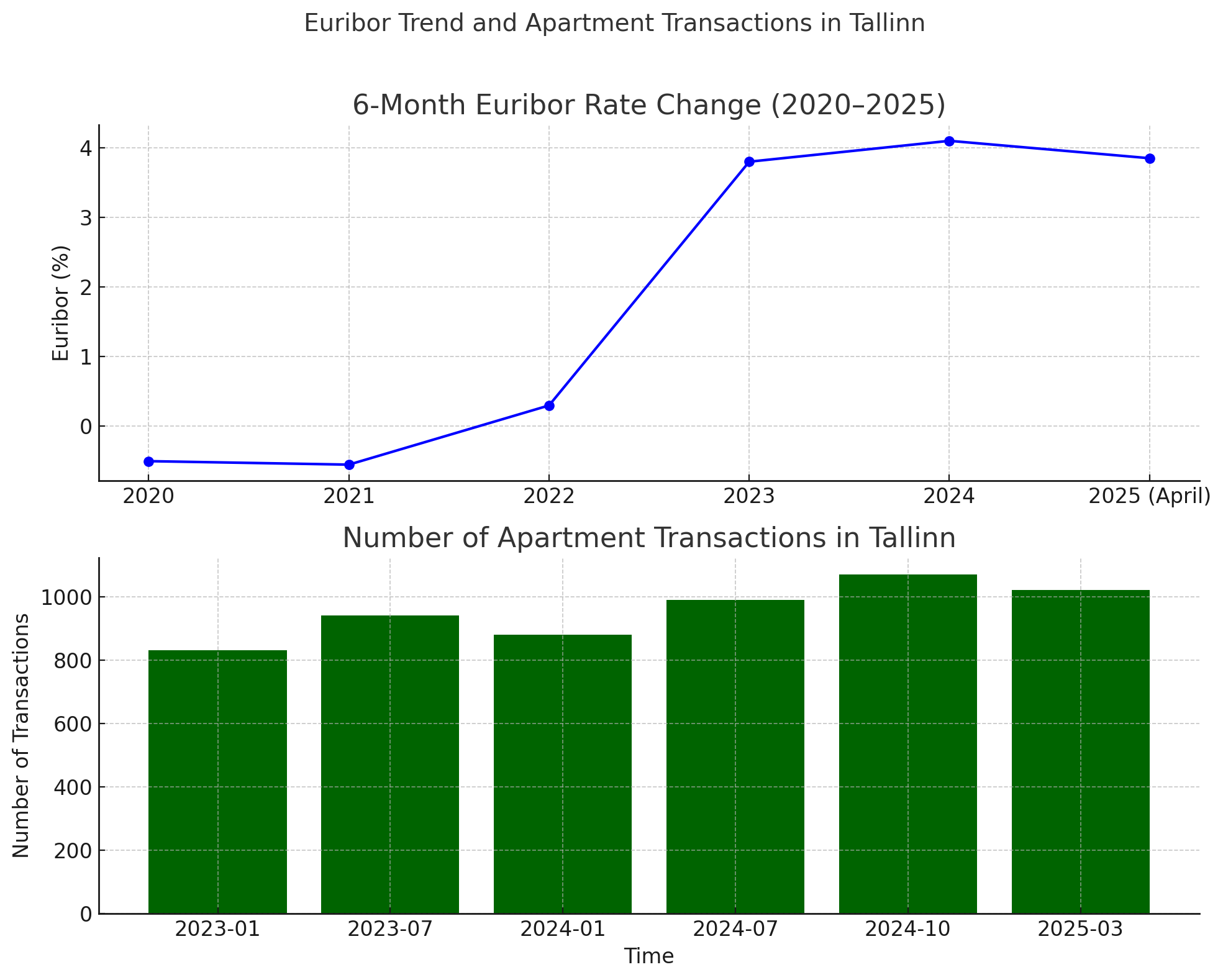
The top graph illustrates the development of the 6-month Euribor from 2020 to April 2025—showing a shift from negative territory to a sharp rise, and now a mild downward trend. The bottom chart shows the dynamics of apartment transactions in Tallinn, highlighting a noticeable rebound at the end of 2024 and relative stability in early 2025.
Tallinn Apartment Market Dynamics
Tallinn’s apartment market has undergone significant changes in recent years. In 2023, transaction volumes were lower. However, in 2024 the market showed signs of recovery. For example, in October 2024, there were 1,063 property transactions in Tallinn—over 17% more than the previous month. It was also the first time that year that the 1,000 transaction mark was exceeded.
Summary ; The real estate market in 2025 is marked by balance and anticipation. High Euribor rates have cooled activity, but in anticipation of lower interest rates, buyers, investors, and developers are positioning themselves. Those who can act strategically and ahead of time may be among the first to benefit from the upcoming market shift